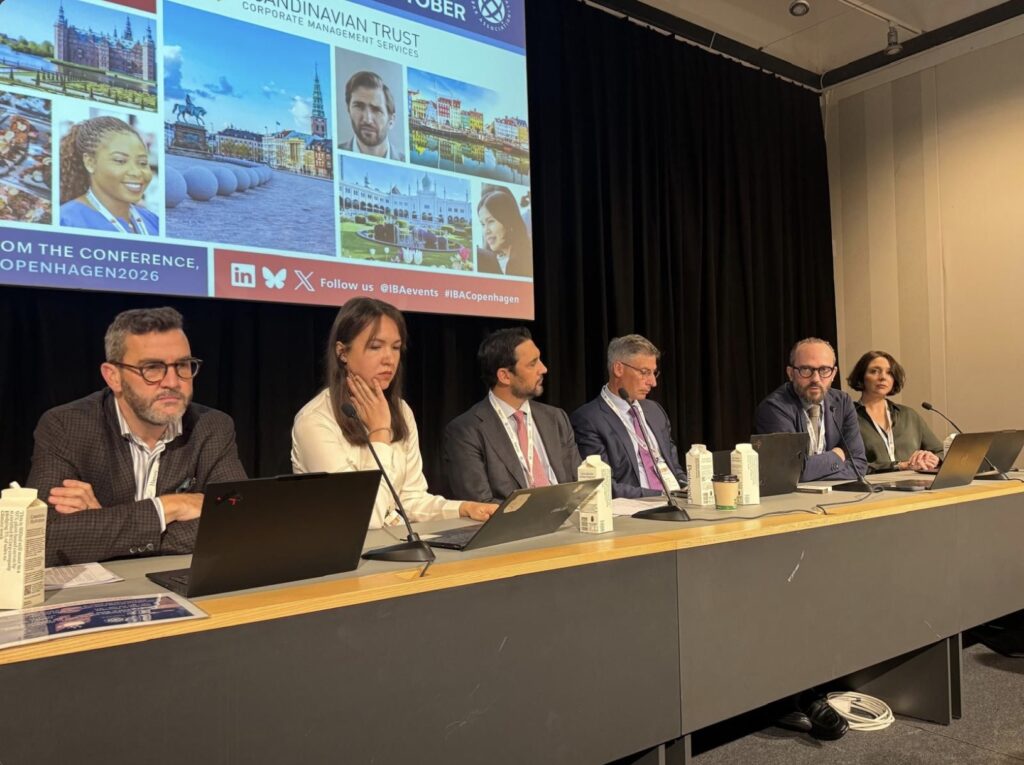
William Julié spoke at the 2026 Annual Conference of the International Bar Association (IBA) in Copenhagen, on the panel “Criminal and rule of law issues that arise from mass migration and the political responses to it”. His presentation addressed the legal responses to the abuses suffered by migrants intercepted in the central Mediterranean and returned to Libyan detention centres.
In 2024 and 2025, 3,013 people were recorded as dead or missing in the central Mediterranean. 48,878 people were intercepted at sea and returned to Libya, to centres where torture is used as a means of extortion. [1]
Can those who, without committing these crimes, make them possible be held accountable? Several courts are now seised of the question.
In Paris, the Investigating Chamber of the Paris Court of Appeal in March 2026 overturned the refusal to open a judicial investigation into the complaint against Fabrice Leggeri, former Executive Director of Frontex, for complicity in crimes against humanity and complicity in torture. [2] The complainants allege that the agency provided the Greek and Libyan coastguards with operational intelligence to intercept and return migrants, and placed its aerial surveillance at the service of interception rather than rescue. Fabrice Leggeri allegedly allowed this to continue, with knowledge of the torture and sexual violence committed in Libyan detention centres. A judicial investigation has been open in France since 13 May 2026. No one has yet been placed under formal investigation. [3]
In Luxembourg, the Court of Justice of the European Union, sitting as the Grand Chamber, held on 18 December 2025 that Frontex bears its own fundamental rights obligations and must verify that every person returned is covered by an enforceable return decision. [4] The Court adapted the burden of proof to the situation of migrants pushed back at sea, who have no means of documenting their own removal. As the European Court of Human Rights held in S.S. and Others v Italy that a Libyan interception in international waters did not fall within Italy’s jurisdiction under Article 1 of the Convention. [5] the EU courts remain the only forum able to review these obligations.
In The Hague, the International Criminal Court, to which the Security Council referred the situation in Libya in 2011, [6] confirmed in July 2026 seventeen counts of crimes against humanity and war crimes against Khaled El Hishri. A senior figure in a Tripoli militia, the Special Deterrence Forces, he was in charge of the section of Mitiga prison where women and young children were held. He is charged, among other things, with the enslavement and ill-treatment of African migrants between May 2014 and June 2020. [7] It is the first case in the Libya situation to proceed to trial.
These proceedings show how the policy response to migration in the central Mediterranean, at times based on interception and cooperation with the Libyan authorities, is now subject to judicial scrutiny. They raise the question of how national, European and international courts interact in assessing the responsibility of those who design or implement these policies. None has yet been decided on the merits. Their outcome will help define the place of the rule of law in the management of migration flows.
[1] MANUL et HCDH, Business as Usual: Human Rights Violations and Abuses against Migrants, Asylum-Seekers and Refugees in Libya, 17 February 2026, available at: https://www.ohchr.org/sites/default/files/documents/press/2026-02/unsmil-ohchr-business-usual-en.pdf.
[2] Ligue des droits de l’Homme, « Fabrice Leggeri, ancien directeur de Frontex, poursuivi pour complicité de crimes contre l’humanité et de torture », 23 April 2024, available at: https://www.ldh-france.org/fabrice-leggeri-ancien-directeur-de-frontex-poursuivi-pour-complicite-de-crimes-contre-lhumanite-et-de-torture/.
[3] AFP, « Complicité de crimes contre l’humanité : les investigations sur l’eurodéputé RN Fabrice Leggeri officiellement lancées », 13 May 2026, available at: https://www.lagazettefrance.fr/article/complicite-de-crimes-contre-l-humanite-les-investigations-sur-l-eurodepute-rn-fabrice-leggeri-officiellement-lancees.
[4] Judgements of the Court of justice of the European union of18 December 2025, WS e.a. c. Frontex, C-679/23 P ; Hamoudi c. Frontex, C-136/24 P ; press releases n° 158/25 and n° 159/25, available at: https://curia.europa.eu/site/upload/docs/application/pdf/2025-12/cp250158en.pdf ; https://curia.europa.eu/site/upload/docs/application/pdf/2025-12/cp250159en.pdf.
[5] CEDH, 1st sect., 20 May 2025, S.S. et autres c. Italie, req. No. 21660/18.
[6] Security Council of the United Nations, resolution 1970 (2011), S/RES/1970 (2011), 26 February 2011, para. 4.
[7] International Criminal Court, press release, « ICC Pre-Trial Chamber I confirms all charges against Khaled Mohamed Ali El Hishri and commits him to trial », 16 July 2026, available at: https://www.icc-cpi.int/news/icc-pre-trial-chamber-i-confirms-all-charges-against-khaled-mohamed-ali-el-hishri-and-commits.