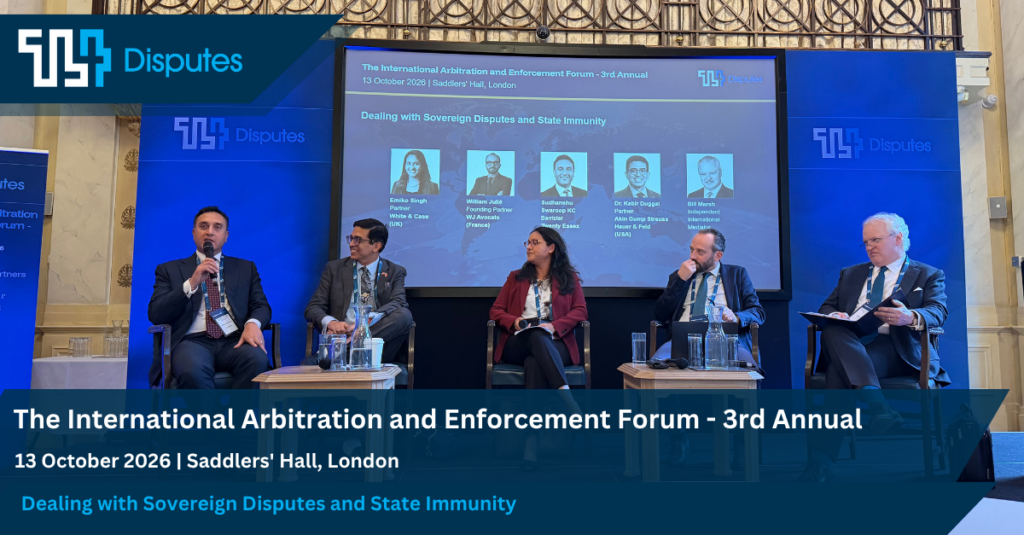
On 13 October 2026, William Julié spoke at the 3rd Annual International Arbitration and Enforcement Forum, organised in London by ThoughtLeaders4, on the panel “Dealing with Sovereign Disputes and State Immunity”. His intervention addressed investment arbitration proceedings brought against EU Member States in connection with EU restrictive measures.
Sanctions litigation is no longer confined to the EU courts. Investment arbitration has become one of its new forums. The Fridman case shows the shift. Mr. Fridman obtained from the General Court of the European Union the annulment of his 2022 listing (Case T-304/22, 10 April 2024), although later renewal acts kept him on the list. He has also brought a USD 16 billion UNCITRAL claim against Luxembourg under the 1989 BLEU-USSR investment treaty, arguing that the freezing of his interests in the Alfa group amounts to expropriation. On 22 September 2026, the Council renewed the individual sanctions regime without maintaining Mr. Fridman on the list, Luxembourg having made his removal a condition of its agreement to the renewal.
EU law closely governs the fate of sanctions-related awards. Article 11 of Regulation (EU) No 833/2014 prohibits satisfying claims brought by Russian persons under contracts affected by the sanctions. The Reibel case (C-802/24) asks whether this provision also prevents arbitrators from hearing such disputes. A Belgian company, refused an export licence, could not deliver to its Russian buyer, and an arbitral tribunal ordered it to repay the advance. Seised of an application to set the award aside, the Svea Court of Appeal referred the question to the Court of Justice. On 26 February 2026, Advocate General Biondi concluded that the dispute remains arbitrable: Article 11 does not bar the proceedings, only the payment of the claim. The judgment is pending.
The Union has also sought to deter such arbitrations. The 18th package (July 2025) prohibits the recognition and enforcement within the EU of awards rendered outside the EU in favour of a Russian claimant. The 20th package (April 2026) further allows any arbitration costs awarded against the claimant to be paid out of its frozen funds.
The right to an effective remedy remains protected. In Case C-384/24 (11 September 2025), the Court of Justice held that the basic needs of a person subject to an asset freeze include the costs of access to justice. Frozen funds may be released to pay court charges, and release cannot be refused on the ground that legal aid is available.