News
News
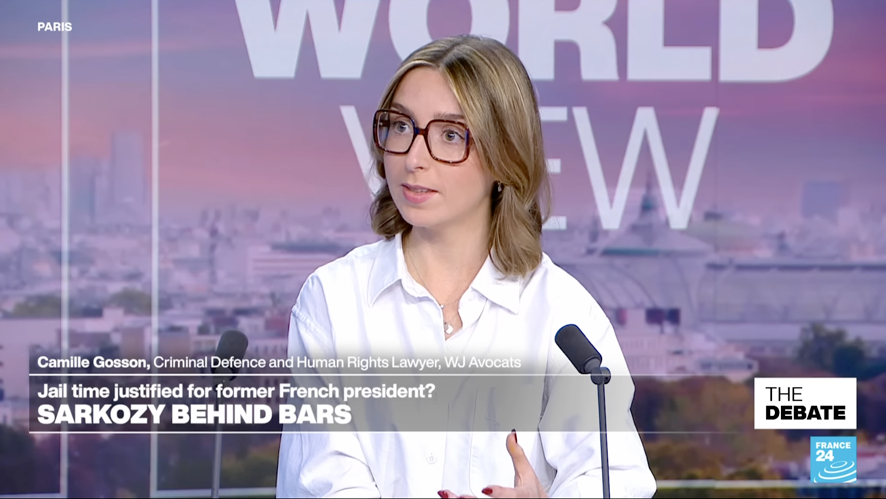
Camille Gosson participated to The Debate, on the day Nicolas Sarkozy started executing his sentence, as the Court of First Instance found him guilty of criminal conspiracy and convicted him to 5 years of imprisonment, with immediate effect, despite his appeal and the principle of suspensive effect under French law.
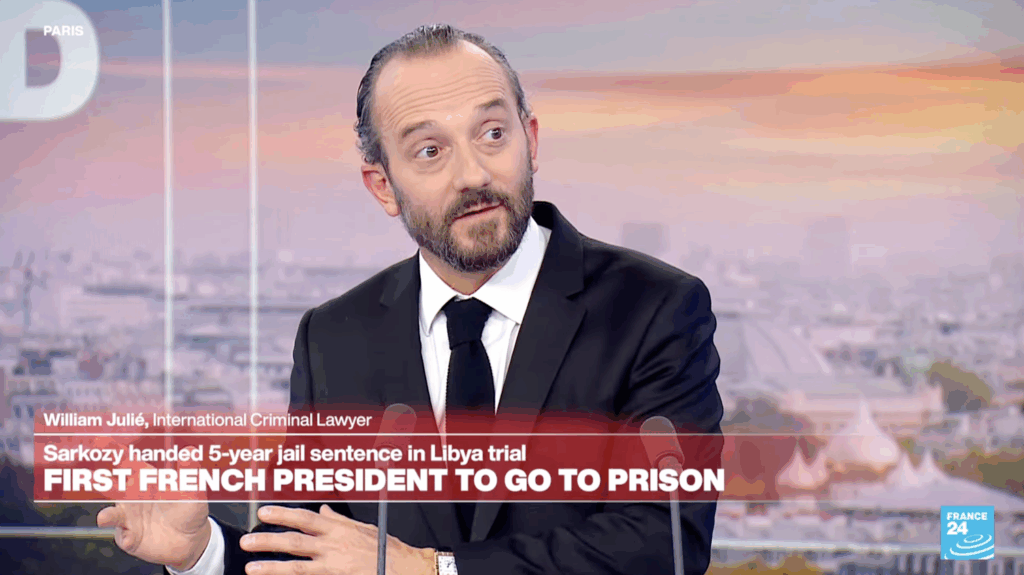
William Julié comments on the recent conviction of former French President Nicolas Sarkozy, who was sentenced to five years’ imprisonment for criminal association in connection with the “Libyan case.” He provides insight into the nature of this offence as well as the mechanism of provisional enforcement of the sentence.
William JULIÉ reacted to Eya’s abduction by her father and the arrest of the latter in Denmark. He explained the rules governing international child abduction, the European arrest warrant mechanism and other points of criminal international law.
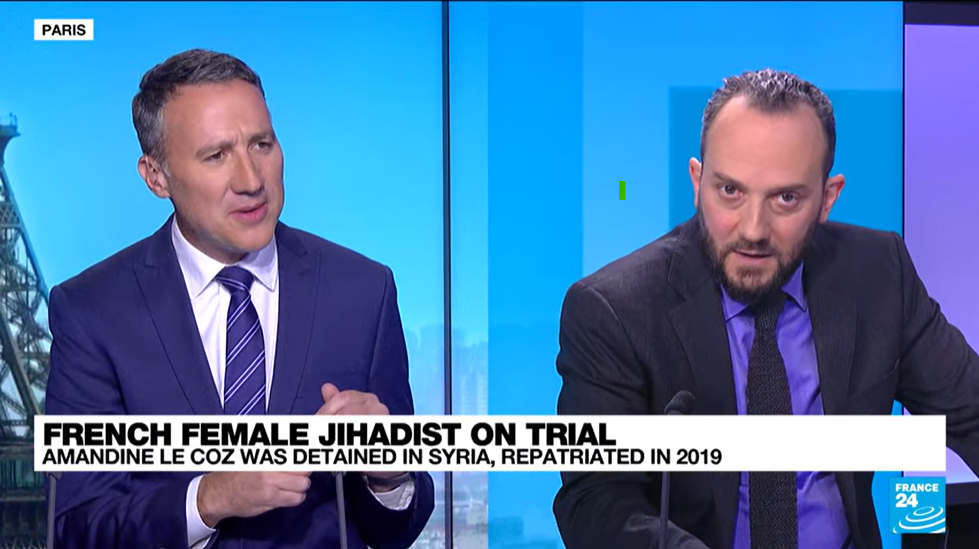
William JULIÉ intervened following the sentencing of Douha Mounib, a French women repatriated from Syria where she joined ISIS, to 12 years in prison. He review the complexe incrimination of terrorist conspiracy and the harsh sentences encountered by their authoris in France and in other EU countries.

“William Julié, criminal and human rights attorney, spoke to France 24’s François Picard about the repatriation of women and children to France from Syrian jihadist camps, following the third major repatriation in six months. This, as rights groups have long pushed for the return of mothers and children to France
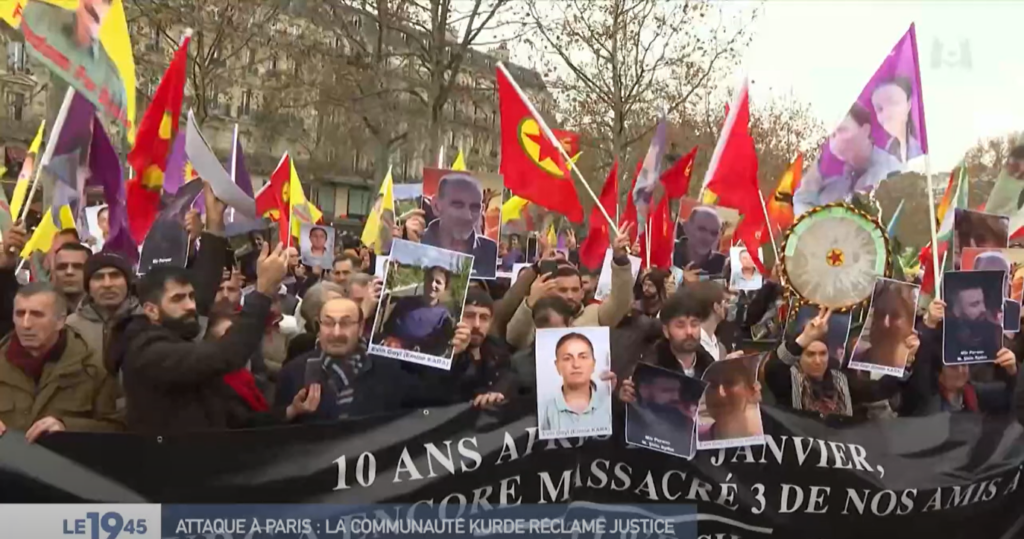
William JULIÉ intervened following the attack on the Kurds in the 10th arrondissement of Paris. He detailed the constitutive elements of the terrorist offence and indicated that the racist motive alone does not characterise this offence.
William JULIÉ gives a quick legal definition of the terrorist act in relation to the massacre in the rue d’Enghien.
William JULIÉ provides details on the arrest of Imam Iquouissen by the Belgian authorities. He explained the modalities of execution of the European arrest warrants. In particular, he detailed the notion of double criminality. While some offences do not require double criminality, in other cases, the executing country must repress
William JULIÉ questioned the compatibility of the decisions of the French Court of Cassation in the Italian “brigadist” cases with articles 2, 6 and 13 of the European Convention on Human Rights and made a number of comments in support of the interests of the Italian State.
William JULIÉ reacted to the international arrest warrant issued by the Pre-Trial Chamber of the International Criminal Court against Vladimir Putin. He spoke of the risks faced by the Russian President and highlighted the difficulties of enforcing this type of arrest warrant.
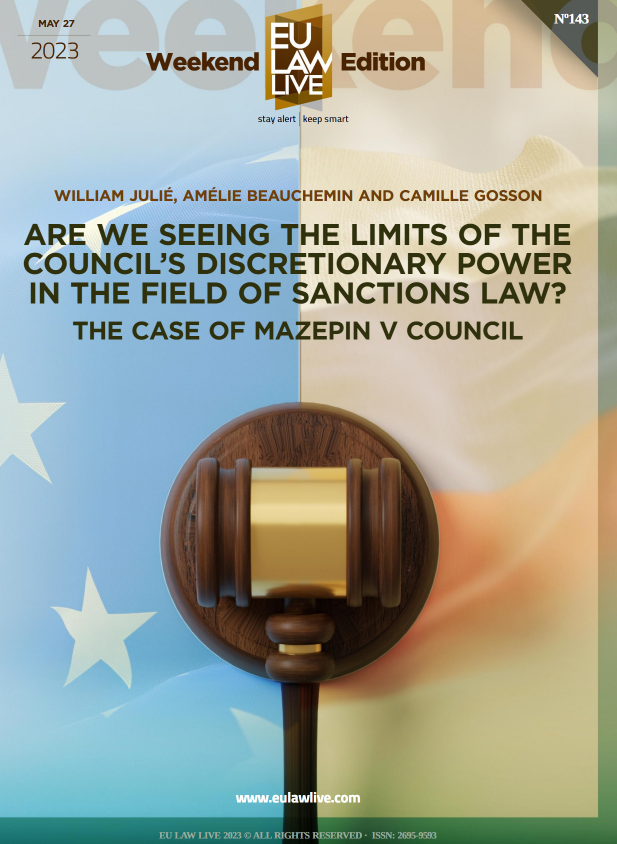
William JULIÉ challenged the arguments put forward by the Council of the European Union to justify placing and keeping his client, Mr AKHMEDOV, on the sanctions list. He also pointed out the material errors and irregularities that have marred the Council’s decisions since the first sanctions were imposed.
The Court of Cassation will rule on the extradition of ten people convicted in Italy during the “Years of Lead”. William JULIÉ made new observations on behalf of the Italian State in the so-called “Brigadist” cases.
William JULIÉ intervened after the attack on rue d’Enghien, in the 10th arrondissement of Paris. He explained that the qualification of a terrorist attack could be retained if its constitutive elements were established.
William JULIÉ gives a quick legal definition of the terrorist act in relation to the massacre in the rue d’Enghien.
William JULIÉ commented on the High Court’s decision concerning the deportation of asylum seekers to Rwanda. This decision authorises such a deportation but obliges the British government to examine the particular situation of the applicants. It does not close the door to an individual appeal to the ECHR, so the
William Julie was asked about the fate of Russian deserters and their possible admission to the European Union. He specified that admission is subject to the rules of each Member State, which lack harmonisation at EU level and have variable delays. He pointed out that since 12 September 2022 the
The Sanctions Committee of the French Anticorruption Agency (AFA) has, for the first time since its creation, imposed a financial penalty [1] on a company and its CEO for failing to fulfil their legal obligations to implement compliance programmes, without a preliminary injunction. As a reminder, the Sapin II Law
🇪🇺 As announced by the European Parliament, the EU is preparing a new sanctions regime targeting migrant smugglers, traffickers and potentially other organised crime actors, adding to the 33 existing EU sanctions frameworks. At first glance, this may seem like a logical step in the fight against organised crime. Targeted
The European Criminal Bar Association has published a report entitled “Safeguarding INTERPOL’s Systems: Recommendations for Reform”, which William Julié and Camille Gosson co-authored with fellow INTERPOL practitioners Vânia Costa Ramos, Rebecca Niblock, Alex Tinsley, Jago Russell, and Sören Schomburg. This report was prepared with the active engagement of the Commission
Review of the 2024 CCF Activity Report, accessible here: https://www.interpol.int/Who-we-are/Commission-for-the-Control-of-INTERPOL-s-Files-CCF/About-the-CCF
Speaking on RFI – Radio France Internationale, William Julié provided his legal analysis of the submission by the israeli NGO Shurat HaDin to the International Criminal Court, highlighting the complexity of the mechanisms for establishing international criminal liability as well as the particularly high evidentiary standards required by the ICC.