News
NEWS
Introduced on 3 March 2026, Bill No. 2544 overhauls the criminal framework governing violations of restrictive measures adopted by the European Union. It seeks to transpose into French law Directive (EU) 2024/1226 of 24 April 2024, which requires Member States to establish criminal offences for violation and circumvention of EU
Review of the 2024 CCF Activity Report, accessible here: https://www.interpol.int/Who-we-are/Commission-for-the-Control-of-INTERPOL-s-Files-CCF/About-the-CCF
On March 4th 2024, Maître Amélie Beauchemin was invited to France24 alongside Charlotte Minvielle, Alice Ackermann and Hélène de Lauzun to debate the recent enshrinement of the freedom to have an abortion in the French Constitution. On March 8th, the French Constitution was amended to include the freedom to have
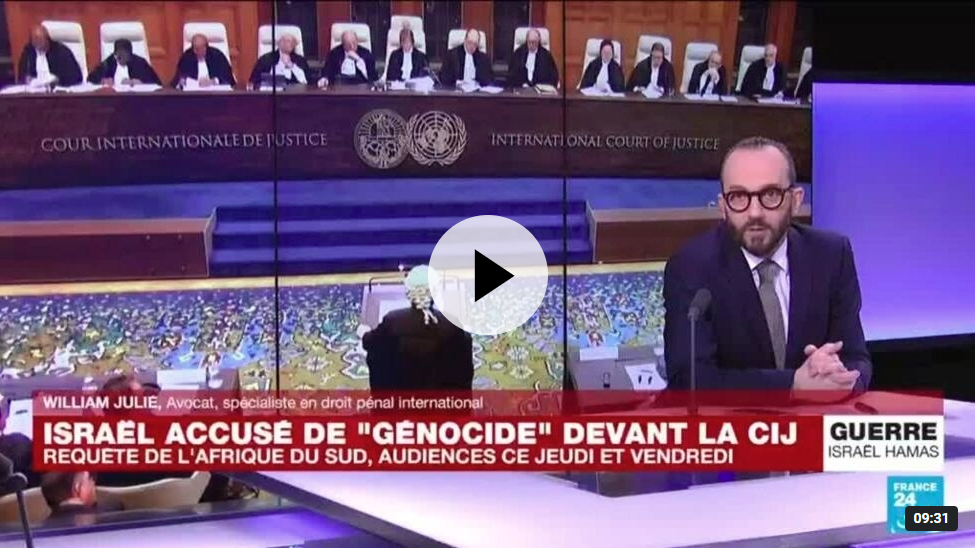
Maître Julié was invited by France 24 following the hearing at the International Court of Justice on the case 𝘚𝘰𝘶𝘵𝘩 𝘈𝘧𝘳𝘪𝘤𝘢 𝘷. 𝘐𝘴𝘳𝘢𝘦𝘭 regarding alleged violations of the Convention on the Prevention and Punishment of the Crime of Genocide by Israel against the Palestinian people in Gaza. In a politically
Maître Julié reacts to the situation of the plane immobilized in the Marne department coming from India, and talks about the asylum application procedure in front of OFPRA to obtain refugee status following suspicions of human trafficking.
Maître William JULIÉ provided details on the complaint lodged by associations regarding racial profiling practices by the police in the context of identity checks. After outlining the scope of such checks and their various legal bases they rely upon, he emphaisized the risks of profiling during administrative police checks in
William JULIÉ debated about the shooting of a teenager by a police officer who is now facing murder charges. He discussed the legal frameworks applicable to the use of firearms by French police but also more in depth the unresolved issues of French society with its banlieues.
William JULIÉ reacted to Eya’s abduction by her father and the arrest of the latter in Denmark. He explained the rules governing international child abduction, the European arrest warrant mechanism and other points of criminal international law.
William JULIÉ intervened following the sentencing of Douha Mounib, a French women repatriated from Syria where she joined ISIS, to 12 years in prison. He review the complexe incrimination of terrorist conspiracy and the harsh sentences encountered by their authoris in France and in other EU countries.
William JULIÉ questioned the compatibility of the decisions of the French Court of Cassation in the Italian “brigadist” cases with articles 2, 6 and 13 of the European Convention on Human Rights and made a number of comments in support of the interests of the Italian State.
William JULIÉ reacted to the international arrest warrant issued by the Pre-Trial Chamber of the International Criminal Court against Vladimir Putin. He spoke of the risks faced by the Russian President and highlighted the difficulties of enforcing this type of arrest warrant.
William JULIÉ challenged the arguments put forward by the Council of the European Union to justify placing and keeping his client, Mr AKHMEDOV, on the sanctions list. He also pointed out the material errors and irregularities that have marred the Council’s decisions since the first sanctions were imposed.
The Court of Cassation will rule on the extradition of ten people convicted in Italy during the “Years of Lead”. William JULIÉ made new observations on behalf of the Italian State in the so-called “Brigadist” cases.
William JULIÉ intervened after the attack on rue d’Enghien, in the 10th arrondissement of Paris. He explained that the qualification of a terrorist attack could be retained if its constitutive elements were established.
William JULIÉ gives a quick legal definition of the terrorist act in relation to the massacre in the rue d’Enghien.
William JULIÉ commented on the High Court’s decision concerning the deportation of asylum seekers to Rwanda. This decision authorises such a deportation but obliges the British government to examine the particular situation of the applicants. It does not close the door to an individual appeal to the ECHR, so the
William Julie was asked about the fate of Russian deserters and their possible admission to the European Union. He specified that admission is subject to the rules of each Member State, which lack harmonisation at EU level and have variable delays. He pointed out that since 12 September 2022 the
Warning: Trying to access array offset on false in /home/clients/11730fdd62870e8a421f09fe0bdcb468/sites/wjavocats.com/wp-content/plugins/elementor-pro/modules/dynamic-tags/tags/post-featured-image.php on line 39
William Julie, Sophie Menegon, and Juliette Fauvarque Volume 12, Issue 3 of New Journal of European Criminal Law https://doi.org/10.1177/20322844211026378 This article purports to analyze the role conferred to the requesting State in domestic extradition procedures. Despite the existence of a judicial control over extradition, the majority of States included in
Warning: Trying to access array offset on false in /home/clients/11730fdd62870e8a421f09fe0bdcb468/sites/wjavocats.com/wp-content/plugins/elementor-pro/modules/dynamic-tags/tags/post-featured-image.php on line 39
What is the essence of the rule against the extradition of nationals? In which cases and across which States does it apply?
Warning: Trying to access array offset on false in /home/clients/11730fdd62870e8a421f09fe0bdcb468/sites/wjavocats.com/wp-content/plugins/elementor-pro/modules/dynamic-tags/tags/post-featured-image.php on line 39
The entry into force of the Agreement on cooperation between the United Kingdom and the European Union (hereinafter “EU”) has led to a decrease of certain rights for wanted individuals, but should not in principle, have consequences regarding the protection of fundamental rights.
Warning: Trying to access array offset on false in /home/clients/11730fdd62870e8a421f09fe0bdcb468/sites/wjavocats.com/wp-content/plugins/elementor-pro/modules/dynamic-tags/tags/post-featured-image.php on line 39
On 31 January 2020, the United Kingdom officially left the European Union (« EU »). The transition period provided for by the Agreement on the withdrawal of the United Kingdom from the EU («the Withdrawal Agreement »), during which the Union’s law was still applicable, in particular regarding criminal cooperation,
Warning: Trying to access array offset on false in /home/clients/11730fdd62870e8a421f09fe0bdcb468/sites/wjavocats.com/wp-content/plugins/elementor-pro/modules/dynamic-tags/tags/post-featured-image.php on line 39
This article intends to identify the legal actions which have or could be led against China in order to render this State accountable for the damages caused by the COVID-19. Several proceedings have already been initiated by individuals or NGOs against the Chinese authorities at the domestic or international level.